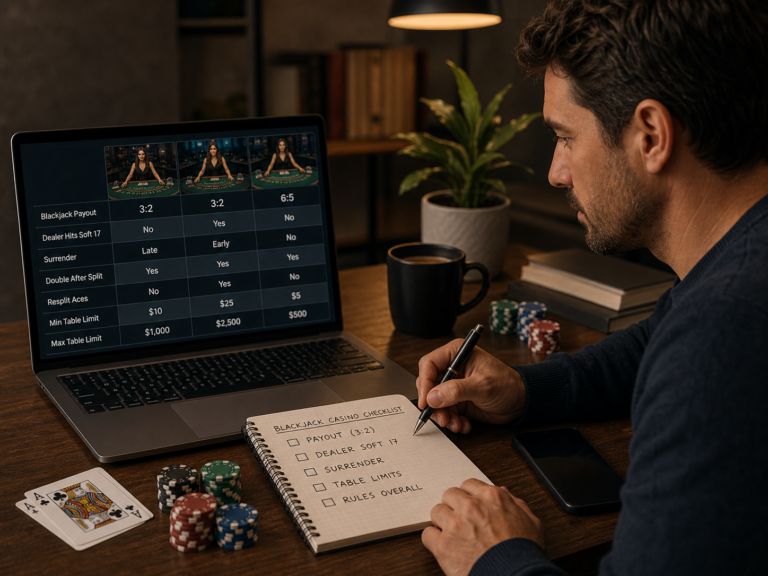

Blackjack is one of the rare casino games where player decisions matter on almost every hand. You cannot remove the house edge with basic strategy alone, and you should not treat blackjack as income, but you can avoid many expensive mistakes by learning the rules, the math, and the table conditions before you play.
This guide explains blackjack from the ground up: how a hand works, why 3:2 payouts matter, what basic strategy does, and how real blackjack history shows the difference between disciplined math and wishful thinking.
Blackjack in One Minute
For the full rules layer, open Blackjack Rules Explained.
The goal is to beat the dealer without going over 21. Number cards count as their face value. Face cards count as 10. Aces count as 1 or 11. A two-card 21, usually an ace plus a ten-value card, is called blackjack or a natural.
Players act first. You can usually hit, stand, double down, split pairs, and sometimes surrender depending on table rules. After players finish, the dealer follows fixed rules. The dealer usually hits until 17 or higher, but some tables require the dealer to hit soft 17. That one rule changes the house edge.
Why Blackjack Is Different From Slots
Slots are mostly about game selection, RTP, volatility, and bankroll. Once the spin starts, the player has no meaningful decision. Blackjack is different because your choices alter expected value. Hitting 16 against a dealer 10 may feel uncomfortable, but standing is often worse. Splitting 8s can feel strange when the dealer shows a strong card, but it is usually the mathematically correct play.
This decision layer is why blackjack attracts strategy-minded players. It is also why many casual players lose more than the posted house edge suggests. Theoretical blackjack edges assume correct basic strategy. Deviate often, take insurance, play 6:5 games, or ignore soft-hand rules, and the cost rises.
The Rules That Matter Most
| Rule | Why It Matters |
|---|---|
| Blackjack pays 3:2 vs 6:5 | 3:2 is much better. 6:5 adds a major cost to the player. |
| Dealer stands or hits soft 17 | Dealer standing on soft 17 is generally better for the player. |
| Double after split | Being allowed to double after splitting improves player value. |
| Surrender | Late surrender can reduce losses in bad spots when used correctly. |
| Number of decks | Fewer decks can be better, but only when paired with good rules. |
Wizard of Odds calculations show how much rules matter. In one six-deck example where the dealer stands on soft 17, simplified strategy produces a house edge around 0.93%, while correct basic strategy can reduce it to around 0.41%. That difference sounds small until you scale it. On $10,000 of lifetime blackjack wagers, 0.93% implies about $93 in theoretical loss; 0.41% implies about $41.
Basic Strategy: What It Is and Is Not
The decision chart is expanded in Blackjack Basic Strategy.
Basic strategy is a chart of the mathematically best decision for each player hand against each dealer up-card under a specific rule set. It is not a betting system. It does not predict the next card. It does not guarantee a winning session. It simply reduces avoidable mistakes.
Think of basic strategy as defensive driving. It will not control the traffic, but it keeps you from making bad turns. If you play blackjack casually, learning even a simplified version can save money compared with guessing.
Beginner Strategy Rules
A full chart is best, but beginners can start with a simplified framework:
- Stand on hard 17 or higher.
- Stand on hard 12-16 when the dealer shows 2-6.
- Hit hard 12-16 when the dealer shows 7-A, with rule-specific exceptions.
- Always split aces and 8s.
- Never split 10s or 5s.
- Double 11 against most dealer cards when allowed.
- Avoid insurance and even money in normal play.
This is not a replacement for a chart, especially with soft hands and pair splits. But it is much better than playing by hunch.
Why Insurance Is Usually a Bad Bet
Insurance is offered when the dealer shows an ace. It is a side bet that pays if the dealer has blackjack. It may feel protective, but for most players it carries a high house edge because you are betting on whether the hole card is a ten-value card without enough information. Wizard of Odds basic strategy guidance repeatedly emphasizes avoiding insurance and even money for ordinary players.
3:2 vs 6:5: The Payout That Changes the Game
If you bet $10 and receive a blackjack, a 3:2 table pays $15. A 6:5 table pays $12. That $3 difference happens only on naturals, but naturals occur often enough to matter dramatically. A table with polished felt, low minimums, and friendly signage can still be poor value if blackjack pays 6:5.
For beginners, this is one of the easiest rules to check. If you remember only one table-selection rule, remember this: prefer 3:2 blackjack and avoid 6:5 unless you fully understand the cost.
The MIT Blackjack Team: The Useful Lesson
The MIT Blackjack Team became part of gambling folklore because students and alumni used card counting, team roles, bankroll discipline, and training to beat blackjack games over time. Their story inspired books, documentaries, and the film 21, though entertainment versions take liberties.
The practical lesson is not that every player should count cards. Online blackjack, continuous shuffling, casino countermeasures, and legal restrictions make that a complicated topic. The lesson is that blackjack rewards disciplined math. The team succeeded by treating every decision as measurable: rules, edge, bet sizing, role assignment, and variance. Casual players can adopt the safer version of that mindset: choose better rules, use basic strategy, track sessions, and set limits.
Bankroll Management for Blackjack
Budget choices connect naturally to Casino Bankroll Management.
Blackjack can feel less volatile than slots, but it can still swing quickly. A common recreational approach is to divide your session bankroll into at least 20-40 betting units. If your session budget is $200, a $5 or $10 table is more realistic than a $25 table. This does not improve the house edge; it simply reduces the chance that normal variance ends the session too quickly.
Set a stop-loss and a time limit before the first hand. Do not raise bets because you are angry. Do not chase a shoe. The cards do not owe you a correction.
Online Blackjack vs Live Dealer Blackjack
Digital blackjack uses software and RNG outcomes. Live dealer blackjack uses real cards streamed from a studio or casino environment. The experience is different, but the review checklist is similar: rules, payout, speed, bet limits, surrender availability, doubling rules, and table transparency.
Live blackjack can be slower, which may help bankroll control. RNG blackjack can be fast, which increases turnover. More hands per hour means the theoretical edge applies to more wagers. Speed is not neutral.
FAQ
Can basic strategy beat blackjack?
Usually no. Basic strategy reduces the house edge but does not normally create a player edge. Advantage play requires additional methods and conditions, and it is not suitable for most recreational players.
What is the best blackjack table for beginners?
Look for low minimums, blackjack pays 3:2, dealer stands on soft 17 if available, double after split allowed, and clear rules. Avoid side bets until you understand their house edge.
Is online blackjack fair?
Licensed operators in regulated markets must use tested games and follow technical standards. Still, players should check licensing, provider reputation, and rules before playing.
Sources and Further Reading
- Wizard of Odds: Blackjack basic strategy calculator
- Wizard of Odds: basic strategy examples and house edge discussion
- UK Gambling Commission: random number generation technical standards
A Practical Hand Walkthrough
Imagine you are dealt 16 against a dealer 10. Many beginners stand because 16 feels close to 21 and hitting risks busting. Basic strategy often says to hit, or surrender if late surrender is available under the right rules. The reason is not that hitting feels good; it is that standing leaves you hoping the dealer busts from a strong position. Over many hands, the less painful-looking option can still be the more expensive one.
Now imagine a pair of 8s against a dealer 9. Keeping 16 feels miserable, and splitting creates two weak starting hands. Yet splitting 8s is usually correct because it turns one bad hand into two hands with a chance to improve. Blackjack strategy is full of these moments. The correct play often feels counterintuitive because humans notice the immediate bust more than the long-run expectation.
Side Bets: Entertainment, Not Core Strategy
Modern blackjack tables often offer side bets such as Perfect Pairs, 21+3, or insurance-like propositions. They add excitement, but many carry higher house edges than the main game. A player who carefully chooses a 3:2 table and uses basic strategy can give back that advantage by overplaying side bets. The simplest beginner rule is to treat side bets as occasional entertainment only, not part of a serious strategy.
How to Review Blackjack Casinos
A blackjack-focused casino review should check more than whether the game exists. It should list blackjack variants, minimum and maximum bets, payout ratio, dealer soft-17 rule, surrender availability, double rules, split rules, live dealer providers, and table speed. A casino with ten blackjack tables is not automatically better than one with three if the three have clearer rules and better limits for beginners.
Casino101 should link this guide to future pages such as Best Blackjack Casinos, Blackjack Basic Strategy, Common Blackjack Mistakes, and Casino Bankroll Management. Together, those pages create a complete blackjack cluster: rules, strategy, mistakes, bankroll, and casino selection.
Final Beginner Rule
Do not sit at a blackjack table because it looks cheap. Sit because the rules are understandable and the stakes fit your budget. A $5 6:5 game may be worse value than a $10 3:2 game, depending on how much and how long you play. Cheap minimums can hide expensive rules.
Blackjack guide next-step note
If you are choosing where to play after learning the rules, move from this guide into How to Choose Blackjack Casinos and then check Best Blackjack Casinos. The rule sheet matters before the logo does.