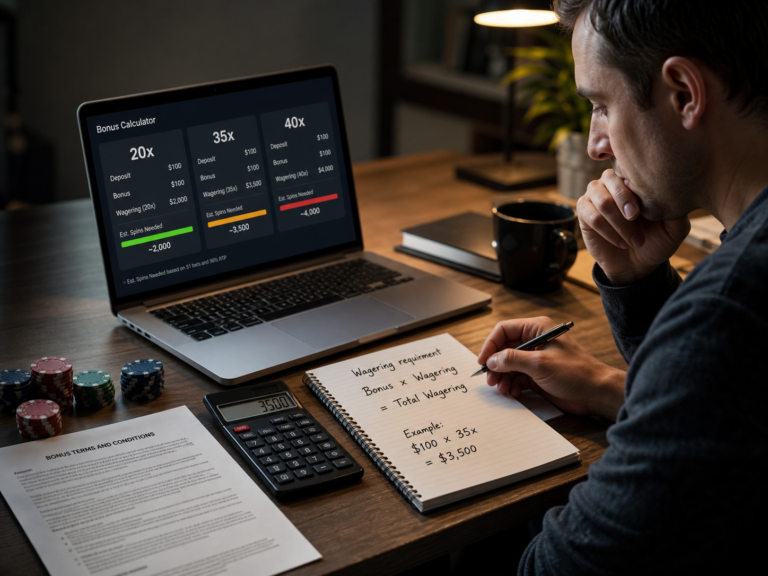

Casino bankroll management is not a way to beat the house. It is a way to keep gambling in the category where it belongs: paid entertainment. A bankroll plan decides how much you can afford to spend, how much you will stake, when you will stop, and what tools you will use if the session stops feeling calm.
This guide is deliberately practical. It is not about “systems” that promise profit. It is about limits, math, and habits that reduce avoidable harm.
What Is a Casino Bankroll?
A bankroll is the amount of money set aside for gambling entertainment. It should be separate from rent, bills, savings, debt payments, family expenses, and emergency funds. If losing the money creates stress, it is not a gambling bankroll.
A session bankroll is the amount you bring to one gambling session. A monthly bankroll is the amount you are willing to spend across a longer period. Good bankroll management defines both.
The Three-Limit Model
| Limit | Example | Purpose |
|---|---|---|
| Monthly budget | $200 | Caps total entertainment spend. |
| Session budget | $50 | Prevents one session from using the whole month. |
| Bet size | $0.25-$1 spins or $5 blackjack hands | Controls session speed and variance. |
The exact numbers depend on income, responsibilities, and comfort. The principle does not: set limits before playing, not during a losing streak.
Bet Sizing for Slots
Slot bet sizing changes with Slots Volatility Explained.
For slots, beginners can often keep bets around 0.5%-2% of the session bankroll. If your session budget is $100, that means $0.50-$2 per spin. A high-volatility slot should usually be at the lower end because dry spells can be long.
At $5 per spin, a $100 bankroll allows only 20 full losing spins. At $0.50, it allows 200. Smaller bets do not change the house edge, but they make the session less fragile.
Bet Sizing for Blackjack
Blackjack players should also review Blackjack Basic Strategy.
Blackjack has a lower theoretical house edge than many casino games when rules are good and basic strategy is accurate, but it still swings. A recreational player with a $200 session budget may prefer $5 hands over $25 hands. That creates more decision opportunities and reduces the chance that a few unlucky hands end the session.
Do not raise stakes to recover losses. Chasing changes the session from entertainment into pressure.
Stop-Loss and Win Goals
A stop-loss is the amount you are willing to lose before ending the session. A win goal is a point where you pause, cash out, or reduce stakes. These tools are not magic. They do not change expected value. They help protect decisions when emotion rises.
Example: $100 session budget, stop at $40 remaining, pause at $150. If you hit either point, leave the game or take a real break. The power is in following the rule when you do not feel like following it.
Deposit Limits and Cooling-Off Tools
Licensed gambling sites often offer deposit limits, loss limits, session reminders, time-outs, and self-exclusion tools. Responsible gambling organizations such as the National Council on Problem Gambling encourage players to use limits and seek help when gambling causes financial, emotional, or relationship harm.
Set deposit limits immediately after creating an account, before a promotion or losing session changes your mood. Limits work best when they are boring and automatic.
Bonus Bankroll Mistakes
Bonuses can distort bankroll decisions. A player may deposit more than planned to unlock a higher bonus tier. Another may raise stakes to finish wagering before expiry. Both decisions let the promotion control the bankroll.
The correct order is budget first, bonus second. If the bonus does not fit the budget, skip the bonus. A promotion is not a coupon if it pushes you into spending more than planned.
A Real-World Lesson From Advantage Play
The MIT Blackjack Team is often remembered for card counting, but bankroll discipline was just as important. A small mathematical edge does not help if bet sizing is reckless or records are poor. Recreational players do not need team-level systems, but they can borrow the sober part of the lesson: track money, define risk, and stop treating outcomes as personal destiny.
Tracking Template
A simple tracking note can include:
- Date and casino.
- Deposit amount.
- Bonus claimed or skipped.
- Starting balance.
- Game and stake size.
- Stop-loss and win goal.
- Final balance.
- How the session felt.
The emotional note matters. If several sessions include words like rushed, angry, secretive, or desperate, that is more important than the balance number.
Warning Signs
- Gambling with money needed for bills.
- Chasing losses.
- Hiding gambling from people close to you.
- Increasing deposits after feeling stressed.
- Ignoring limits you set earlier.
- Thinking gambling is a solution to financial problems.
If any of these are familiar, stop playing and use support resources. In the US, the National Problem Gambling Helpline is available at 1-800-GAMBLER. In the UK, GamCare and the National Gambling Helpline offer support and guidance.
Internal Reading Path
This page should link into every major casino cluster: Blackjack Guide, How to Play Slots, Roulette Strategy Guide, How Casino Bonuses Work, and Responsible Gambling. Bankroll guidance is not a side note; it is the safety layer under the whole site.
FAQ
Can bankroll management make gambling profitable?
No. It controls risk and session pacing. It does not remove the house edge.
How much should I bet per spin?
Many beginners keep slot bets around 0.5%-2% of the session bankroll, lower for high-volatility games.
Should I use casino deposit limits?
Yes, especially if you play regularly. Limits are most useful when set before emotions enter the session.
Sources and Further Reading
- National Council on Problem Gambling: help and treatment
- GamCare: safer gambling information
- UK Gambling Commission: safer gambling guidance
Monthly Budget Example
Assume a player decides that $240 per month is an affordable entertainment budget. A practical structure might be six $40 sessions or four $60 sessions. If the player loses the monthly budget by the 15th, the correct action is not to reload. The correct action is to wait until the next month. A budget only works if the empty budget means play stops.
This is why online deposit limits are useful. They turn the plan into a system. Willpower is weakest during emotional moments, so the best time to create protection is before the session starts.
Game Choice and Bankroll Speed
Different games consume bankroll at different speeds. A $1 slot spin every five seconds creates $720 in hourly turnover if played continuously. A blackjack table at $10 per hand and 60 hands per hour creates $600 in hourly turnover. A live dealer game may be slower, which can help some players keep pace under control. Turnover matters because house edge applies to wagers, not deposits.
| Game Style | Example Pace | Hourly Turnover |
|---|---|---|
| Fast slot | $1 every 5 seconds | About $720 |
| Slower slot | $0.50 every 8 seconds | About $225 |
| Blackjack | $10 x 60 hands | About $600 |
These are pace examples, not exact predictions. They show why speed belongs in bankroll planning. A game can have a low house edge and still create high turnover if it is played quickly.
Bankroll and Content Trust
Casino101 should link bankroll management from every promotional article. A bonus page that never mentions budget looks like advertising. A bonus page that explains limits, wagering, and when to skip the offer reads like editorial guidance. That distinction matters for readers and for long-term SEO trust.
What to Do After a Big Win
A win can be as risky as a loss because it can encourage higher stakes. A simple rule is to withdraw part of the win, reduce stake size, or end the session. Do not let a lucky result rewrite the budget. The money is not truly yours to use elsewhere until it is withdrawn and clear of bonus restrictions.
What to Do After a Loss
After a loss, do not immediately open another casino account, claim a new bonus, or raise the stake to recover. Take a break, record the session, and let the budget reset on its normal schedule. Chasing losses is one of the clearest warning signs that gambling has stopped being entertainment.
Bankroll Rules by Player Type
| Player Type | Safer Bankroll Habit | Reason |
|---|---|---|
| Beginner | Small session budgets and low stakes | Learning should not be expensive. |
| Bonus user | Calculate wagering before deposit | The bonus may require more turnover than expected. |
| Slot fan | Match stake to volatility | High volatility needs more room for swings. |
| Blackjack player | Use basic strategy and avoid side-bet habits | Main-game edge can be low, side bets often cost more. |
The 24-Hour Rule
If you feel tempted to increase your deposit after a losing session, wait 24 hours. The delay breaks the emotional chain between loss and reload. It also gives you time to check whether the next deposit fits the monthly budget. A planned deposit is entertainment. An angry deposit is a warning sign.
How This Supports SEO and Trust
Bankroll content strengthens every commercial page because it shows readers that Casino101 is not only pushing signups. Link this article from bonus pages, game guides, casino reviews, and payment pages. The more visible the safety layer is, the more credible the affiliate layer becomes.
More FAQ
Should I track wins and losses?
Yes. Tracking turns vague impressions into facts. Many players underestimate losses when they remember only memorable wins.
When should I stop gambling completely?
Stop if gambling affects bills, work, relationships, sleep, or emotional stability. Use self-exclusion and support services if stopping feels difficult.