
Most blackjack mistakes are not dramatic. They are small, repeated decisions: taking insurance because it sounds safe, playing a 6:5 table because the minimum is low, standing on hard 16 because busting feels embarrassing, or raising the bet after three losses. The cost comes from repetition.
This guide focuses on the common beginner mistakes that quietly increase the house edge and make blackjack more stressful than it needs to be.
Mistake 1: Playing 6:5 Blackjack
A 3:2 blackjack pays $15 on a $10 bet. A 6:5 blackjack pays $12. The difference seems small because it happens only when you get a natural, but naturals occur often enough for the rule to matter. A table can advertise low minimums and still be expensive if blackjack pays 6:5.
Before sitting down, check the felt or game rules. If the payout says 6:5, treat it as a warning sign. Beginners should usually search for 3:2 games, even if the minimum is slightly higher and still within budget.
Mistake 2: Taking Insurance
Insurance feels like protection when the dealer shows an ace. In reality, it is a side bet on whether the dealer has a ten-value hole card. Without card-counting information, insurance is usually a poor bet. It can also distract players from the main hand decision.
The phrase “even money” makes the same issue sound safer when you have blackjack against a dealer ace. For ordinary basic strategy players, the answer is usually no.
Mistake 3: Ignoring Basic Strategy
Blackjack gives players decisions, and decisions have mathematical cost. Guessing may feel more personal, but the game does not reward personal feelings. Basic strategy exists because each hand can be measured against the dealer up-card over many repetitions.
A player who knows only a few rules is still better off than a player who guesses everything. Stand on hard 17+, split aces and 8s, avoid splitting 10s, and learn hard 12-16 decisions. Then keep improving.
Mistake 4: Misplaying Soft Hands
Soft hands are often misplayed because the total looks safe. A soft 18 feels like a made hand, but against certain dealer cards it may be a hit or double depending on rules. The ace gives flexibility, and basic strategy uses that flexibility aggressively.
Mistake 5: Splitting by Emotion
Splitting 10s feels exciting, but breaking a 20 is usually a mistake. Refusing to split 8s feels safe because it avoids putting more money out, but keeping 16 is weak. Pair strategy is one of the clearest places where emotion and math disagree.
Mistake 6: Overplaying Side Bets
Side bets add entertainment and sometimes big payouts, but they often carry higher house edges than the main game. A player can choose a good 3:2 table, use basic strategy, and then give away value through repeated side bets. If you play side bets, treat them as separate entertainment with a small budget.
Mistake 7: Chasing Losses
Chasing is not a strategy. It is an emotional reaction. Raising stakes after losses increases volatility and can break your session budget quickly. A good blackjack session plan includes a stop-loss before the first hand is dealt.
Mistake 8: Playing Too Fast Online
Online RNG blackjack can be very fast. More hands per hour means more turnover. If a game has a 0.7% theoretical edge and you play $10 hands slowly, the cost develops gradually. If you play hundreds of hands quickly, turnover rises and variance hits harder. Speed is part of bankroll management.
Mistake 9: Using the Wrong Strategy Chart
Rules matter. A chart for a game where the dealer stands on soft 17 may differ from one where the dealer hits soft 17. Surrender availability changes some stiff-hand decisions. Number of decks can change borderline plays. Use a chart that matches the table.
Case Study: The Expensive “Safe” Stand
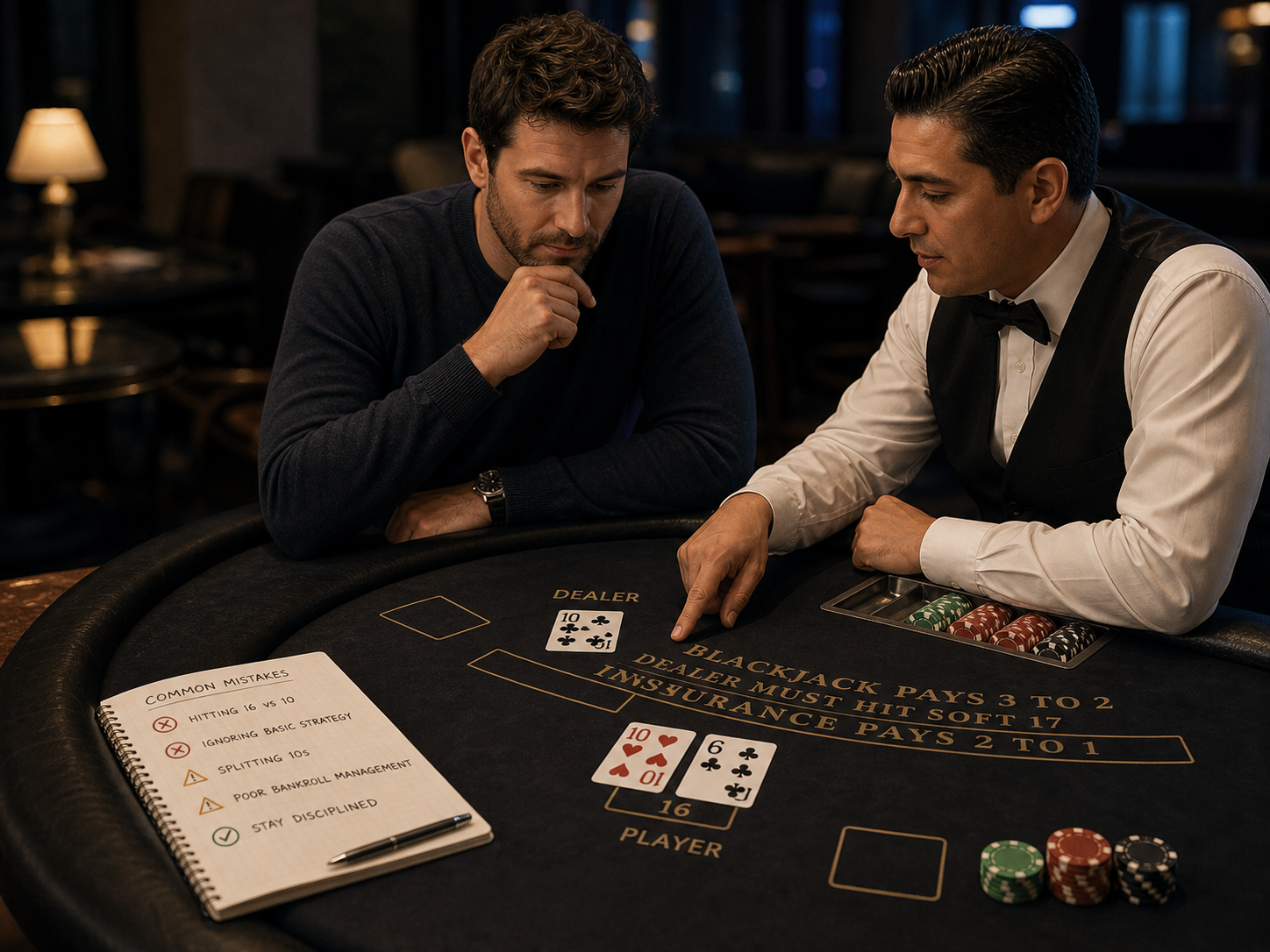
Hard 16 against dealer 10 is the classic uncomfortable hand. Standing avoids the immediate pain of busting, but it leaves you against a strong dealer position. Basic strategy often says hit or surrender if available. The lesson is psychological: the move that feels safer in the moment can be more expensive over time.
Historical Lesson
The MIT Blackjack Team story is usually told as a card-counting adventure, but the deeper lesson is discipline. They practiced, tracked errors, and treated deviations as costs. Beginners can copy that habit without copying advantage play: keep notes, review mistakes, and respect the chart.
Correction Checklist
- Play 3:2 tables when possible.
- Decline insurance and even money in ordinary play.
- Use a rule-matched basic strategy chart.
- Keep side bets small or skip them.
- Set stop-loss and session time limits.
- Do not increase stakes to recover losses.
Internal Reading Path
This article should sit after Blackjack Rules and Blackjack Basic Strategy. It should link to Casino Bankroll Management because many mistakes are really budget mistakes wearing a strategy costume.
FAQ
What is the biggest beginner blackjack mistake?
Playing poor rules, especially 6:5 blackjack, and ignoring basic strategy are two of the largest recurring mistakes.
Are other players’ decisions hurting me?
Not in the way many players believe. Over time, other players’ hits and stands do not systematically change your expectation. Focus on your own decisions.
Should I quit after a mistake?
If the mistake came from emotion or fatigue, taking a break is smart. If it was a chart error, note it and practice.
Sources and Further Reading
- Wizard of Odds: blackjack odds and rules
- Wizard of Odds: basic strategy calculator
Mistake 10: Blaming Other Players
Blackjack tables create social pressure. If another player hits when you think they should stand, it can feel like they “took the dealer’s bust card.” Over time, this belief does not hold up. Other players’ decisions can change the order of cards in individual hands, sometimes helping and sometimes hurting. They do not create a reliable disadvantage for you. Focusing on them distracts from your own decisions.
Mistake 11: Confusing a Winning Session With Good Play
A beginner can play badly and win. A strong player can follow basic strategy and lose. Short sessions are noisy. Review decisions, not only outcomes. If you split 10s, take insurance, chase losses, and still leave ahead, the session result does not make those decisions correct.
Mistake 12: Ignoring Game Speed
Live dealer blackjack might deal 40-80 hands per hour depending on table conditions. Fast RNG blackjack can move much quicker. If your average bet is $10, speed changes turnover dramatically. More turnover means more exposure to both variance and house edge. Beginners who play online should slow down deliberately: no rapid rebetting after emotional hands, no autoplay-like behavior, and scheduled breaks.
How to Audit Your Own Play
After a session, write down five hands you were unsure about. Look them up against a rule-matched strategy chart. If the same mistake appears repeatedly, practice that category before the next session. This is how blackjack becomes less mysterious. You are not trying to eliminate losses; you are trying to eliminate avoidable errors.
Casino101 Review Angle
Those review signals feed into Best Blackjack Casinos.
Blackjack mistake content should link naturally to casino reviews. A casino that pushes 6:5 tables, high-pressure side bets, and fast play should score lower for beginner suitability. A casino with clear 3:2 live tables, low limits, and visible rules should score higher. The education content directly supports commercial recommendations.
More FAQ
Is card counting a beginner goal?
No. Beginners should first learn rules, basic strategy, and bankroll control. Counting is a separate advanced topic and often impractical online.
What should I do if I keep making the same mistake?
Lower stakes or stop real-money play while practicing that decision category. Repetition fixes what willpower does not.
Why Mistake Articles Convert Well
Mistake articles work well for SEO because they meet readers at a moment of uncertainty. A player who searches “should I take insurance in blackjack” is closer to a real decision than someone casually searching “casino games.” That makes the article valuable for internal links to Blackjack Basic Strategy, Blackjack Rules, and eventually Best Blackjack Casinos.
Editorial Notes Before Publishing
Before publishing, consider adding one screenshot-style example for each major mistake: 6:5 payout, insurance prompt, side-bet panel, and soft-hand decision. Keep the tone nonjudgmental. The goal is to help readers improve, not shame them for beginner errors.
Recovery Plan After a Bad Session
If a session goes badly, do not immediately search for a new casino bonus or raise the next deposit. Review whether the loss came from normal variance, poor rules, emotional betting, or strategy errors. Each cause has a different fix. Variance requires acceptance, poor rules require better table selection, emotional betting requires a break, and strategy errors require practice.
This recovery mindset keeps the article aligned with responsible gambling instead of turning mistakes into another reason to keep playing.
Final Mistake Reminder
The most dangerous mistakes are the ones that feel reasonable in the moment: protecting a hand with insurance, chasing one more win, or choosing a worse table because the minimum is lower. A good blackjack player is not someone who never loses. It is someone who knows which losses came from the game and which came from avoidable choices.